

close
Choose Your Site
Global
Social Media


 |


As a premier manufacturer and supplier of industrial material handling components, we engineer high-performance heavy-duty polyurethane rollers designed to conquer the most demanding operational environments. Sourced directly from our advanced production facilities, these rollers serve as the robust foundation for modern automated systems and heavy machinery.
Product Description JIUNA specializes in casting compact polyurethanes for medium and large sized polyurethane industrial wheels and coated rollers designed for heavy-duty applications, manufactured according to client specifications. |  |
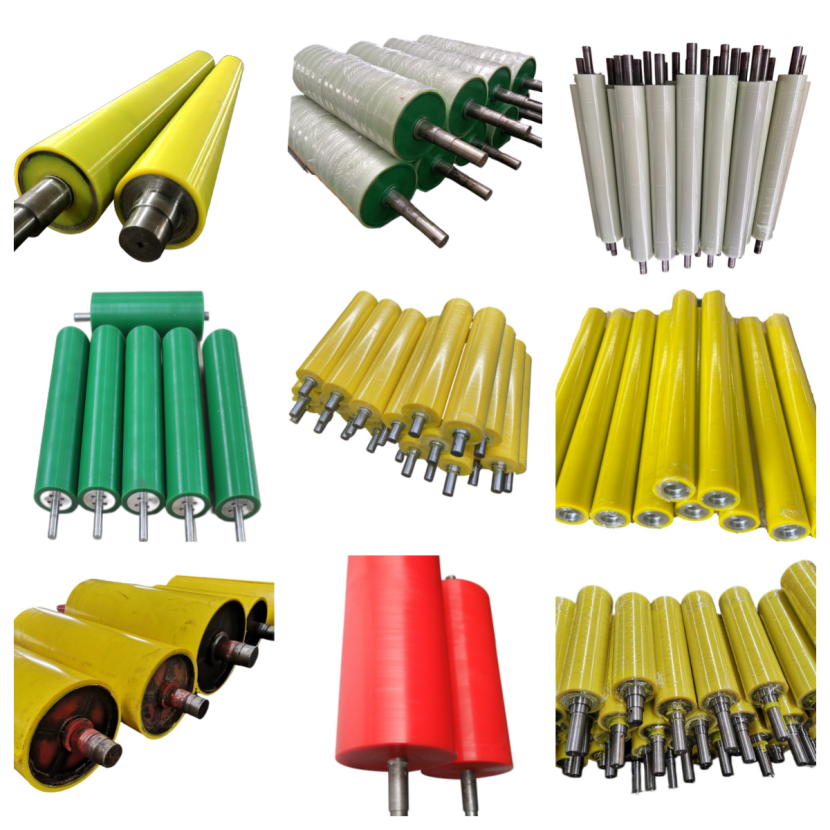 | Industrial Rollers With Polyurethane Coating For metal hub coverings, we employ various polyurethane types with hardness levels ranging from 70 to 95 Sh°A, selected based on intended use. Our materials ensure optimal durability, performance, resistance to abrasion, and protection against chemical agents, making them suitable for diverse industrial applications. |
Properties | Test Method | Values | Units |
Hardness | DIN 2240-91 | 72 (-) | 78 (-) | 83 (-) | Shore A (Shore D) |
100% Modulus | BS 903 Pt. A2 - ISO 37 | 500 (3.4) | 510 (3.5) | 700 (4.8) | lb/in2 (Mpa) |
300% Modulus | BS 903 Pt. A2 - ISO 37 | 900 (6.2) | 840 (5.8) | 1340 (9.2) | lb/in2 (Mpa) |
Tensile Strength | BS 903 Pt. A2 - ISO 37 | 3700 (25.8) | 4000 (27.6) | 4150 (28.6) | lb/in2 (Mpa) |
Elongation at Break | BS 903 Pt. A2 - ISO 37 | 630 | 600 | 530 | % |
Tear Strength | BS 903 Pt. A3 - ISO 34-1 | 360 (63.0) | 370 (64.8) | 400 (70.1) | lb/in (KN/m) |
Compression Set | BS 903 Pt. A6 - ISO 815 | 27 | 22 | 30 | % |
Abrasion Loss | DIN 53516 | 52 | 32 | 48 | mm³ |
Resilience | ASTM D 2632-92 | 62 | 59 | 54 | % |
Specific Gravity | 1.05 | 1.05 | 1.06 | g/cm³ |
Attribute | Value |
Material | Polyurethane |
Colour | Any colour |
Hardness | 75-90A Shore |
Product Name | Pu Rollers |
Transport Package | Be Packed in Export-Applicable Tray |
HS CORD | 3926909090 |
Apply | Material Handling Forklift |
Production Capacity | 3000 Piece/Pieces Per Month |
Common Applications
· Fork lift trucks
· Wire-guided conveyor systems and wheels for AGV systems
· Coated rollers for wood or glass working systems
· Industrial systems in the mineral and extraction sector
· Wheels for professional scrubbers-dryers and floor sweepers
· Big cargo polyurethane wheels
· Automated warehouse systems
· Heavy-duty wheels for refuse compactors
· Cement-mixers for transport and production
· Wheels for tracks
· Applications in water and sea-water environments
· Polyurethane wheels and casters for bottling machines
Our industrial polyurethane rollers are engineered to resolve the most persistent mechanical challenges faced by facility operators and equipment engineers. By focusing on molecular-level material enhancements and macro-level structural integrity, these rollers deliver transformative operational benefits.
Acoustic Dampening Capabilities: The inherent elasticity of our polyurethane compound absorbs kinetic vibrations, drastically reducing operational noise levels and creating a safer, more compliant auditory environment for facility personnel.
Chemical & Solvent Immunity: Formulated to repel degradation from exposure to harsh industrial lubricants, hydraulic fluids, and cleaning solvents, ensuring the roller surface does not swell, crack, or become brittle over time.
Optimized Rolling Resistance: The precise formulation of the PU tread minimizes the energy required to initiate and maintain movement, directly translating to lower power consumption for automated guided vehicles (AGVs) and conveyor drive motors.
Thermal Stability: Capable of maintaining consistent durometer ratings and physical dimensions even under the heat generated by high-speed, continuous friction applications.
Designed specifically for punishing industrial environments, these rollers boast an exceptionally high compression modulus and a remarkably low compression set (22%-30%). When heavy machinery remains stationary for extended periods, inferior wheels develop permanent "flat spots," causing severe vibration upon startup. Our advanced polymer matrix actively resists this deformation, instantly rebounding to its perfectly cylindrical shape to guarantee smooth, continuous high-load operation.
Tread separation is the most catastrophic failure point in high-stress applications. We eradicate this risk through a sophisticated metal hub surface preparation and a proprietary thermo-chemical bonding process. The adhesive force between the polyurethane and the metal core far exceeds the tear strength of the polymer itself. Whether subjected to rapid acceleration, aggressive braking, or high-torque cornering, the tread remains permanently fused to the hub, safeguarding your production line from unexpected downtime.
In environments plagued by metallic shavings, crushed stone, or abrasive dust, equipment survival depends on surface resilience. Our meticulously selected polyurethane formulas achieve an incredibly low abrasion loss of 32-52 mm³ and a massive tear strength of up to 400 lb/in. This means the rollers literally push sharp debris aside rather than allowing it to puncture or shred the tread, multiplying the component's lifespan exponentially compared to traditional rubber or nylon alternatives.
A roller is only as efficient as its rotational axis. We integrate premium-grade sealed precision bearings housed within CNC-machined metal cores featuring ultra-low Total Indicator Runout (TIR). This obsessive attention to concentricity eliminates eccentric wobbling at high speeds. The result is a dramatic reduction in rolling resistance and parasitic vibration, which not only maximizes power transmission efficiency but also protects the internal bearings from premature fatigue.
Heavy loads typically mean destroyed facility floors, but our non-marking polyurethane chemistry breaks this cycle. The material glides seamlessly over expensive epoxy or polished concrete without leaving scuffs, gouges, or carbon tracks. Furthermore, the inherent chemical inertness of the PU protects against oil and grease absorption. For specialized environments, we easily adapt the formula to include anti-static (ESD) or hydrolysis-resistant properties, ensuring perfect adaptation to any micro-climate.
No two industrial applications are identical, which is why we offer comprehensive geometric and material customization. Choose from a broad durometer spectrum (70A for maximum traction and shock absorption, up to 95A for minimal rolling resistance). Beyond hardness, our engineering team precisely machines the roller surfaces into V-grooves for pipe lines, U-grooves for wire guidance, crowned profiles for belt tracking, or specialized anti-slip textures to perfectly synchronize with your proprietary equipment architecture.
Selecting the right manufacturing partner is as critical as selecting the right component. We bring decades of specialized expertise in polymer casting and precision metallurgy to your supply chain, ensuring every roller delivered meets exacting global standards.
End-to-End Quality Control: From raw material inspection to final dynamic load testing, our rigorous QA protocols guarantee absolute consistency across batches of thousands.
Rapid Prototyping & Engineering Support: Our technical team collaborates directly with your engineers, translating complex operational challenges into precise CAD models and functional prototypes within accelerated timeframes.
Scalable Production Readiness: With a dedicated capacity of 3,000 pieces per month, we seamlessly transition from bespoke trial runs to full-scale, uninterrupted volume fulfillment.
Global Logistics Expertise: Utilizing export-applicable tray packaging, we ensure your critical components arrive in pristine condition, regardless of the destination.
Connect with our global engineering network today to discuss your specific load and environmental requirements:
We understand that specifying industrial components requires deep technical clarity. Below are detailed answers to the most stringent questions posed by equipment designers and procurement engineers.
How do you prevent the polyurethane from debonding from the metal core under high torque?
We utilize a highly controlled, multi-stage thermo-chemical bonding process. The metal hubs undergo rigorous surface preparation, including degreasing and abrasive blasting, before a specialized bonding agent is applied. The polyurethane is then cast and cured at precise temperatures, creating a cross-linked molecular bond that is stronger than the tear strength of the polyurethane itself, effectively eliminating the risk of delamination.
Can these rollers withstand continuous 24/7 operation in automated warehouses without developing flat spots?
Absolutely. Our rollers are formulated with a very low compression set (22%-30%) and high resilience (54%-62%). This specific polymer matrix ensures excellent memory retention. Even when subjected to heavy static loads during system pauses, the material instantly recovers its perfectly round shape upon movement, preventing flat spotting and ensuring smooth AGV navigation.
What customization options are available for the roller surface and geometry?
We offer extensive deep customization. Beyond adjusting the hardness (70-95 Shore A) and color, our CNC machining capabilities allow us to profile the polyurethane surface to your exact specifications. This includes V-grooves, U-grooves, crowned faces, flanged edges, and custom tread patterns designed to optimize traction and tracking for your specific rail or conveyor system.
Are your polyurethane rollers resistant to industrial chemicals, oils, and floor cleaning solvents?
Yes, polyurethane naturally possesses superior chemical resistance compared to standard rubber. Our heavy-duty formulation is highly inert and resists degradation, swelling, or hardening when exposed to common industrial fluids, including motor oils, hydraulic fluids, greases, and harsh alkaline floor scrubbers.
How does the Shore A hardness rating affect the roller's performance on my equipment?
The durometer dictates the balance between grip and rolling resistance. A lower hardness (e.g., 70A-75A) provides a larger footprint, offering maximum traction, shock absorption, and noise reduction, ideal for uneven surfaces. A higher hardness (e.g., 90A-95A) minimizes the contact patch, significantly reducing rolling resistance to lower motor strain and support the heaviest loads without excessive deflection. We help you select the exact rating based on your operational priorities.
